Introduction to Graphical Causal Inference

From Averages to Heterogeneity

Moritz Ketzer

Humboldt-Universität zu Berlin

March 10, 2026

Day 2

Adapted from Watson et al. (2025, fig. 1)

What do we know about Open Science?

Variable What the literature tells us
Open Data Incentives and mandates drive sharing (Woods and Pinfield 2022)
Citations Data sharing associated with citation advantage (Piwowar et al. 2007)
Reproducibility Open data enables verification — but evidence is mixed (Hardwicke et al. 2021)
Published Journal mandates link data sharing to publication (Ross-Hellauer et al. 2022)
Rigour Peer review quality varies substantially (Goodman et al. 1994)
Novelty Novel contributions get reused and cited more
Data Reuse Reuse of shared data leads to citation of originals
Field Citation norms and data sharing culture differ across disciplines (Waltman and Van Eck 2019)

Klebel and Traag (2024)

Adapted from Watson et al. (2025, fig. 1)

Define the Causal Question

Does sharing data openly cause more citations?

Exposure

Open Data

binary: shared or not

Outcome

Citations

count

Klebel and Traag (2024)

Adapted from Watson et al. (2025, fig. 1)

Specify the Theoretical Estimand

Individual causal effect

\text{ITE} \;=\; \tau_i \;=\; Y_i(\text{open}) \;-\; Y_i(\text{not open})

\downarrow average over population

\text{ATE} \;=\; \tau \;=\; \mathbb{E}\big[Y_i(\text{open}) \;-\; Y_i(\text{not open})\big]

Unit-specific quantity

How many more citations if this study shared data?

Target population

All published studies? Only in psychology?

Lundberg, Johnson & Stewart (2021)

Adapted from Watson et al. (2025, fig. 1)

Exercise: DAGitty

Textor et al. (2016); Klebel and Traag (2024)

moritzketzer.github.io/iqb-workshop

Open dagitty-open-science.R

Breakout rooms in pairs (~30 min), then 5 min break before debrief.

Adapted from Watson et al. (2025, fig. 1)

Adapted from Watson et al. (2025, fig. 1)

Adapted from Watson et al. (2025, fig. 1)

Heterogeneity

Gelman et al. (2023)

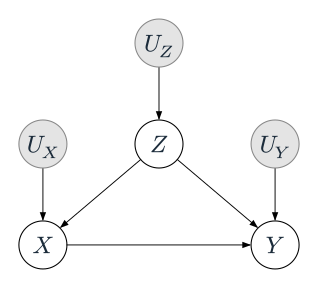
A Linear SCM with Interaction

Structural Equations

\begin{aligned} Z &= U_Z \\ X &= \beta^{XZ} Z + U_X \\ Y &= \beta^{YX} X + \beta^{YZ} Z + \textcolor{#D55E00}{\beta^{YXZ} XZ} + U_Y \end{aligned}

Distributional Assumptions

\begin{pmatrix} U_Z \\ U_X \\ U_Y \end{pmatrix} \sim \mathcal{N}\left(\begin{pmatrix} 0 \\ 0 \\ 0 \end{pmatrix}, \begin{pmatrix} \sigma^2_Z & 0 & 0 \\ 0 & \sigma^2_X & 0 \\ 0 & 0 & \sigma^2_Y \end{pmatrix}\right)
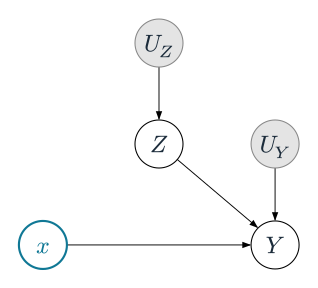
Graph Surgery: Interaction Case

Structural Equations

\begin{aligned} Z &= U_Z \\ X &= \color{#107895}{x} \\ Y &= \beta^{YX} \textcolor{#107895}{x} + \beta^{YZ} Z + \textcolor{#D55E00}{\beta^{YXZ} \textcolor{#107895}{x} Z} + U_Y \end{aligned}

Distributional Assumptions

\begin{pmatrix} U_Z \\ \textcolor{lightgray}{U_X} \\ U_Y \end{pmatrix} \sim \mathcal{N}\left(\begin{pmatrix} 0 \\ \textcolor{lightgray}{0} \\ 0 \end{pmatrix}, \begin{pmatrix} \sigma^2_Z & 0 & 0 \\ 0 & \textcolor{lightgray}{\sigma^2_X} & 0 \\ 0 & 0 & \sigma^2_Y \end{pmatrix}\right)
CATE = \mathbb{E}[Y \mid do(X = x), Z = z] - \mathbb{E}[Y \mid do(X = x'), Z = z]

CATE = \textcolor{#107895}{\beta^{YX}} + \textcolor{#D55E00}{\beta^{YXZ}} z

Estimand
ATE Average over all Z \textcolor{#107895}{\beta^{YX}}
CATE At a specific Z = z \textcolor{#107895}{\beta^{YX}} + \textcolor{#D55E00}{\beta^{YXZ}} z

Gelman et al. (2023)

Estimand Population Averages over
ATE = E[\beta_j] All schools School differences
CATE(j) = \beta_j School j Nothing — school-specific

Backdoor criterion: condition on Z. Done?

But Z = school is not a variable — it’s a cluster.
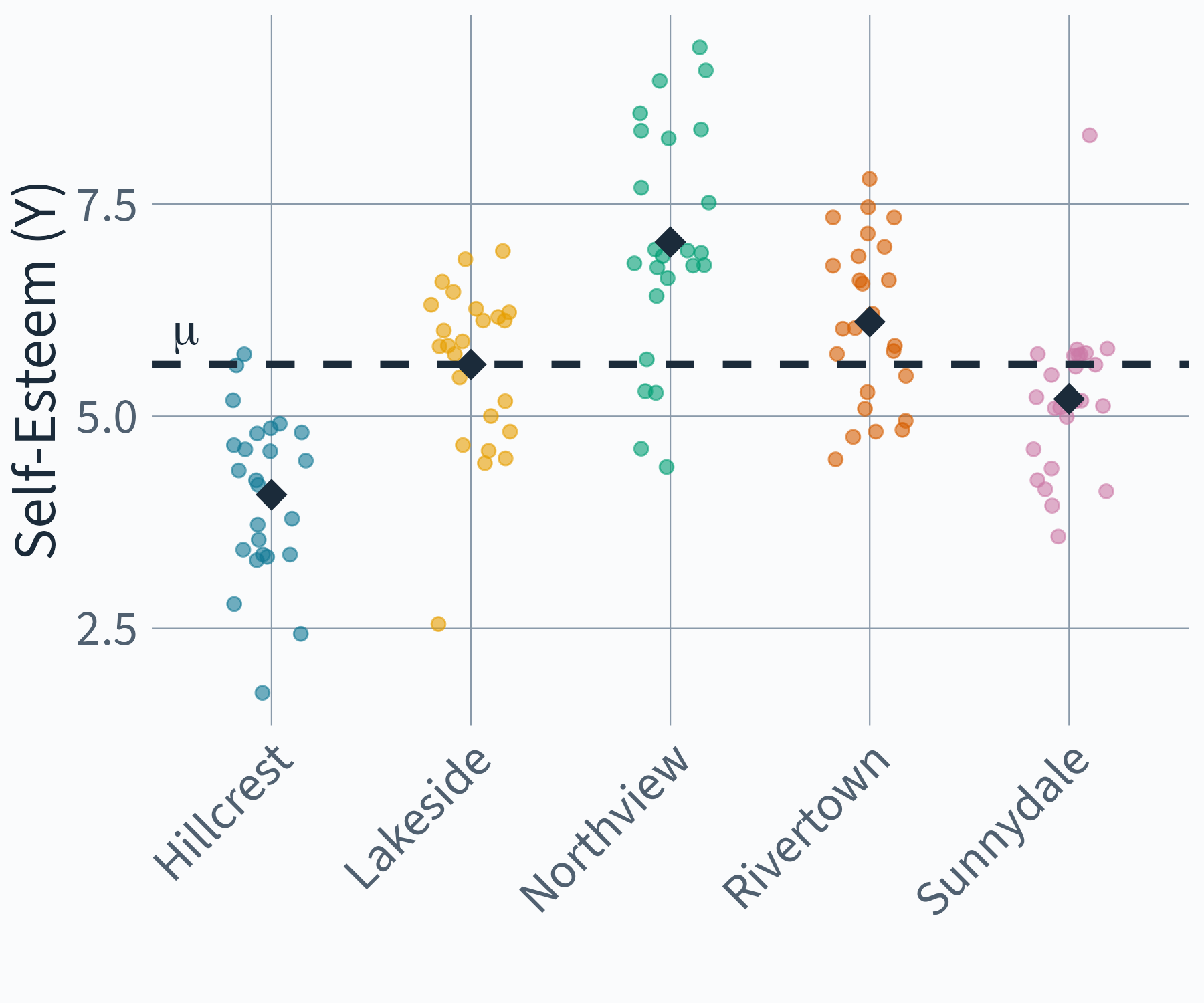
What’s Inside Z?

Multilevel Models

Random Intercept Model

\begin{aligned} y_{ij} &= \eta_{0j} + e_{ij} \\ \eta_{0j} &= \mu + u_{0j} \end{aligned}

Random Intercept Model

\begin{aligned} y_{ij} &= \mu + u_{0j} + e_{ij} \end{aligned}
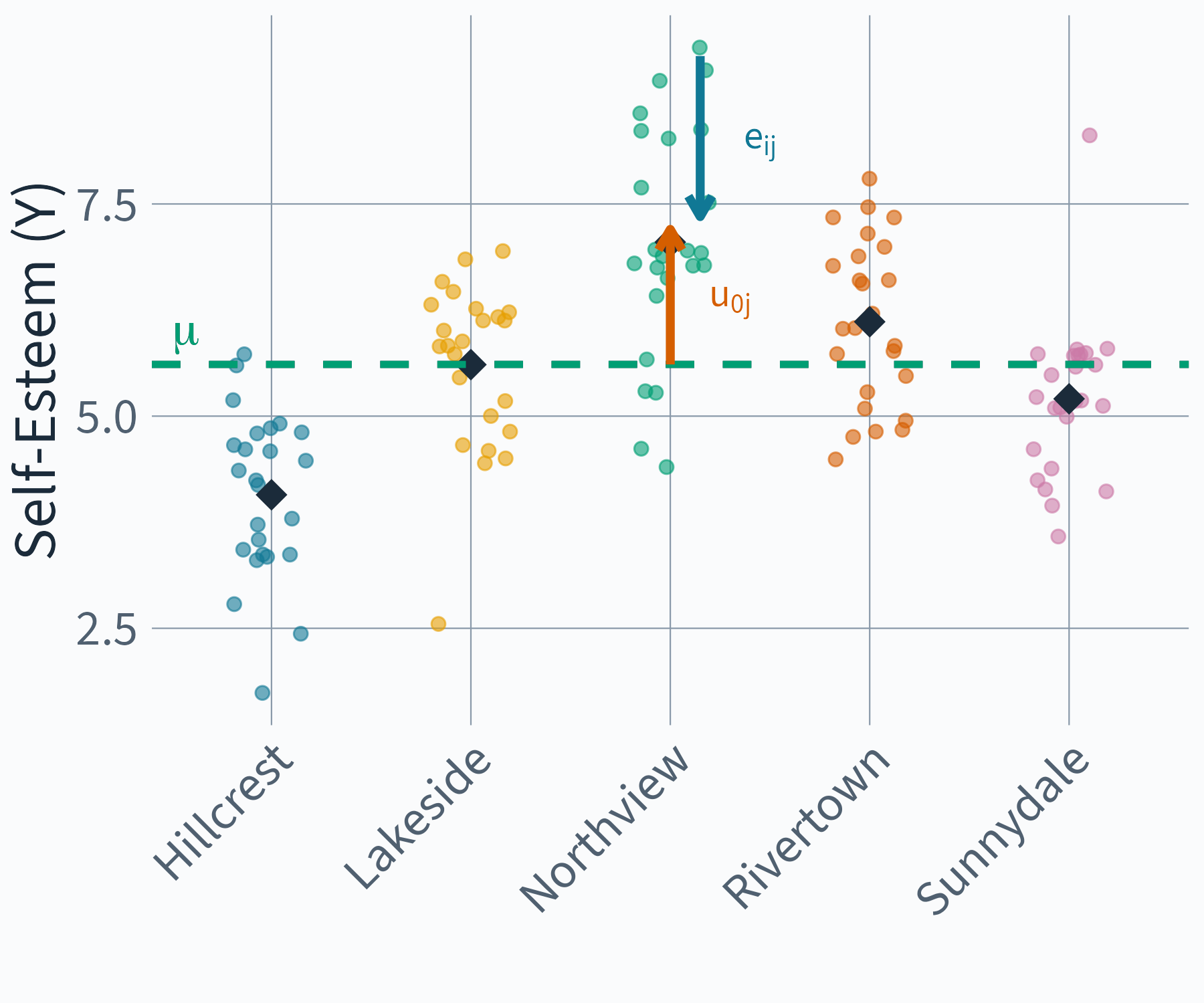
Random Intercept Model

\begin{aligned} y_{ij} &= \color{#009E73}{\mu}\color{black} + \color{#D55E00}{u_{0j}}\color{black} + \color{#107895}{e_{ij}}\color{black} \end{aligned}
Exercise: What Do the Error Terms Mean?

Look at the Random Intercept Model:

y_{ij} = \color{#009E73}{\mu}\color{black} + \color{#D55E00}{u_{0j}}\color{black} + \color{#107895}{e_{ij}}\color{black}

Discuss with your neighbor:

  1. What do \color{#D55E00}{u_{0j}} and \color{#107895}{e_{ij}} represent from a Structural Causal Model perspective?
  2. Can you name concrete examples of what these unobserved causes could be?
  3. Try to sketch the simplest possible DAG for this model — one observed node, two latent error nodes.
  4. What does it mean that we split “unobserved causes” into a between-cluster and a within-cluster component?

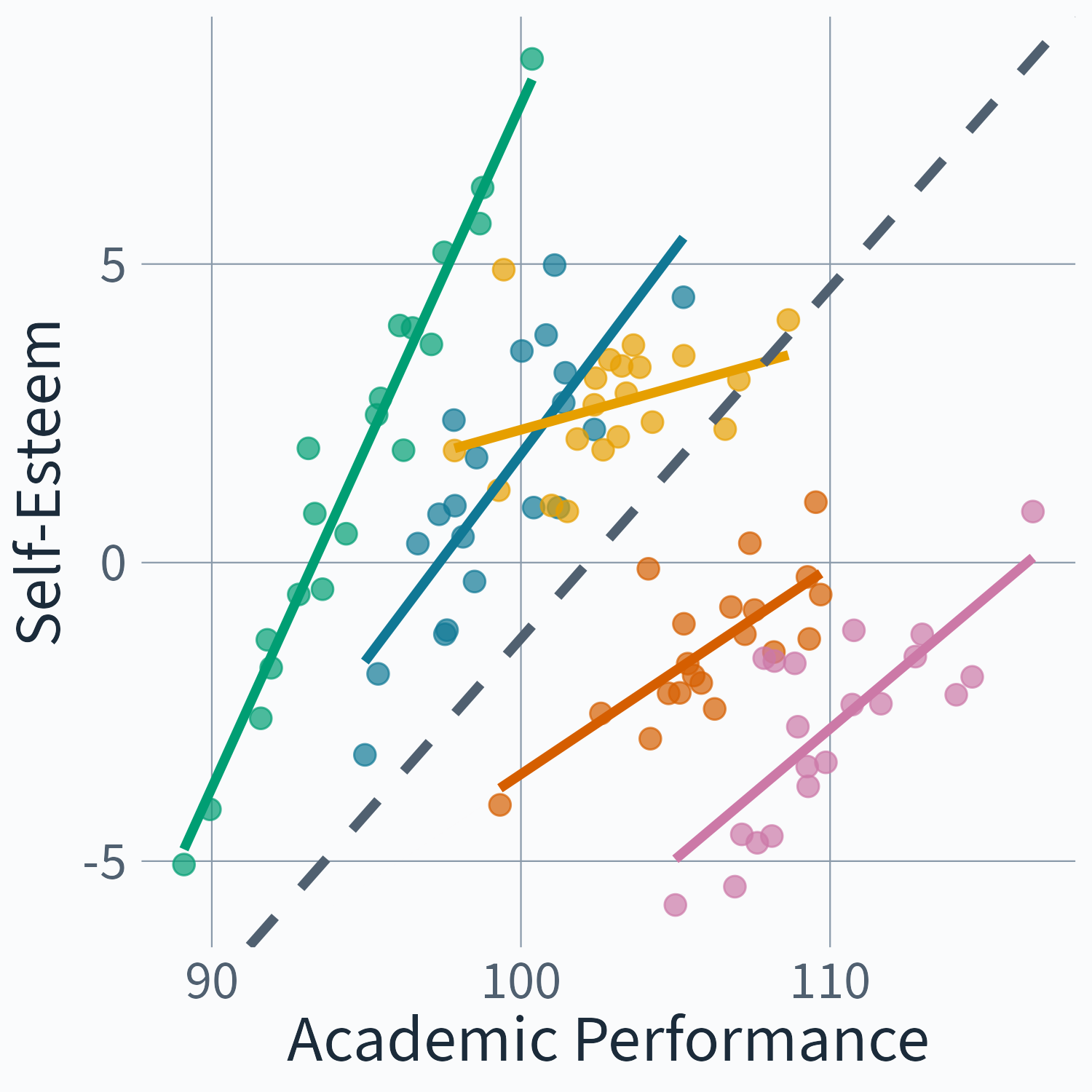
(Illustration of the Big Fish Little Pond Effect based on simulated data, cf. Marsh et al. 2008)

(Illustration of the Big Fish Little Pond Effect based on simulated data, cf. Marsh et al. 2008)

(Illustration of the Big Fish Little Pond Effect based on simulated data, cf. Marsh et al. 2008)

Multi-Level Notation

\begin{aligned} y_{ij} &= \eta_{0j} + \eta_{1j}x_{ij} + e_{ij} \\ \eta_{0j} &= \mu + u_{0j} \\ \eta_{1j} &= \beta + u_{1j} \end{aligned}

Multi-Level Regression Notation

\begin{aligned} y_{ij} &= \eta_{0j} + \eta_{1j}x_{ij} + e_{ij} \\ \eta_{0j} &= \mu + u_{0j} \\ \eta_{1j} &= \beta + u_{1j} \end{aligned}

Mixed-Model Notation

y_{ij} = \color{#D55E00}(\mu + u_{0j})\color{black} + \color{#D55E00}(\beta + u_{1j})\color{black} x_{ij} + e_{ij}

Mixed-Model Notation

y_{ij} = \mu + \beta x_{ij} + u_{1j}x_{ij} + u_{0j} + e_{ij}

Distributional Assumptions

\begin{aligned} \begin{bmatrix} u_{0j}\\ u_{1j} \end{bmatrix} &\sim N\left (\begin{bmatrix} 0\\ 0 \end{bmatrix}, \begin{bmatrix} \psi_{11} \\ \psi_{21} & \psi_{22} \end{bmatrix}\right ) \\ \begin{bmatrix} e_{ij} \end{bmatrix} &\sim N(0,\sigma^2_e) \end{aligned}

Common Path Diagrams for Multilevel Models

(adapted from Curran and Bauer 2007)

(adapted from Muthén and Muthén 2017)

(adapted from Mehta and Neale 2005)

None of them clearly map on to the formal class of DAGs

\begin{array}{c} \text{(Multi-level) SCM} = (\mathcal S, \mathcal P, \mathcal G) \end{array}

\mathcal S = Set of (Multilevel) Structural Equations

\mathcal P = Probability distribution over the exogenous variables

\mathcal G = Graph (DAG or DAMG)

What is a DAMG?

Back to our example

Structural Equations

\begin{aligned} Z &= U_Z \\ X &= \beta^{XZ} Z + U_X \\ Y &= \beta^{YX} X + \beta^{YZ} Z + U_Y \end{aligned}

Distributional Assumptions

\begin{pmatrix} U_Z \\ U_X \\ U_Y \end{pmatrix} \sim \mathcal{N}\left(\begin{pmatrix} 0 \\ 0 \\ 0 \end{pmatrix}, \begin{pmatrix} \sigma^2_Z & 0 & 0 \\ 0 & \sigma^2_X & 0 \\ 0 & 0 & \sigma^2_Y \end{pmatrix}\right)

What if Z is unobserved?

Structural Equations

\begin{aligned} \color{lightgray} Z &\color{lightgray}= U_Z \\ X &= \beta^{XZ} \textcolor{lightgray}{Z} + U_X \\ Y &= \beta^{YX} X + \beta^{YZ} \textcolor{lightgray}{Z} + U_Y \end{aligned}

Distributional Assumptions

\begin{pmatrix} \textcolor{lightgray}{U_Z} \\ U_X \\ U_Y \end{pmatrix} \sim \mathcal{N}\left(\begin{pmatrix} \textcolor{lightgray}{0} \\ 0 \\ 0 \end{pmatrix}, \begin{pmatrix} \textcolor{lightgray}{\sigma^2_Z} & 0 & 0 \\ 0 & \sigma^2_X & 0 \\ 0 & 0 & \sigma^2_Y \end{pmatrix}\right)
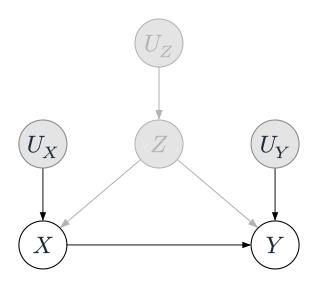
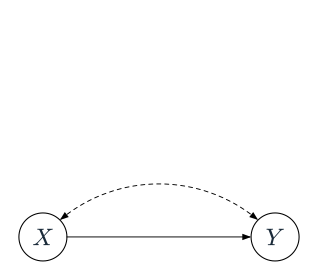
Directed Acyclic Mixed Graphs

Structural Equations

\begin{aligned} X &= E^X \\ Y &= \beta^{YX} X + E^Y \end{aligned}

Distributional Assumptions

\begin{pmatrix} E^X \\ E^Y \end{pmatrix} \sim \mathcal{N}\left(\begin{pmatrix} 0 \\ 0 \end{pmatrix}, \begin{pmatrix} \sigma^2_X & \textcolor{#D55E00}{\sigma_{XY}} \\ \textcolor{#D55E00}{\sigma_{XY}} & \sigma^2_Y \end{pmatrix}\right)
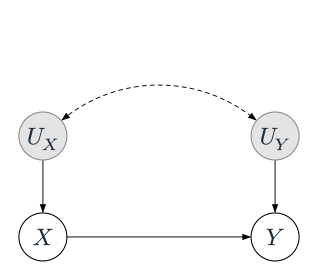
Directed Acyclic Mixed Graphs

Structural Equations

\begin{aligned} X &= E^X \\ Y &= \beta^{YX} X + E^Y \end{aligned}

Distributional Assumptions

\begin{pmatrix} E^X \\ E^Y \end{pmatrix} \sim \mathcal{N}\left(\begin{pmatrix} 0 \\ 0 \end{pmatrix}, \begin{pmatrix} \sigma^2_X & \textcolor{#D55E00}{\sigma_{XY}} \\ \textcolor{#D55E00}{\sigma_{XY}} & \sigma^2_Y \end{pmatrix}\right)
Multi-level Equations

\begin{aligned} \color{#D55E00} X_{ij} &\color{#D55E00}= \eta_{j}^{X\mu} + E_{ij}^{X} \\ Y_{ij} &= \eta_{j}^{Y\mu} + \eta_{j}^{YX} X_{ij} + E_{ij}^{Y} \\ \\ \color{#D55E00} \eta_{j}^{X\mu} &\color{#D55E00} = \mu^{X} + U_{j}^{X\mu} \\ \eta_{j}^{Y\mu} &= \mu^{Y} + U_{j}^{Y\mu} \\ \eta_{j}^{YX} &= \beta^{YX} + U_{j}^{YX} \end{aligned}

Mixed-Model Form = Structural Form

\begin{aligned} X_{ij} &= \mu^{X} + U_{j}^{X\mu} + E_{ij}^{X} \\ Y_{ij} &= (\mu^{Y} + U_{j}^{Y\mu}) + (\beta^{YX} + U_{j}^{YX})X_{ij} + E_{ij}^{Y} \end{aligned}

Mixed-Model Form = Structural Form

\begin{aligned} X_{ij} &= \mu^{X} + U_{j}^{X\mu} + E_{ij}^{X} \\ Y_{ij} &= \mu^{Y} + \color{#D55E00}\beta^{YX}\color{black} X_{ij} + U_{j}^{YX}X_{ij} + U_{j}^{Y\mu} + E_{ij}^{Y} \end{aligned}

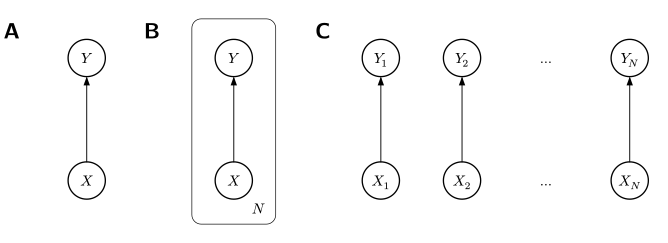
From Single Level to Multi-Level Graphs

Plate Notation

From Independent to Dependent Units
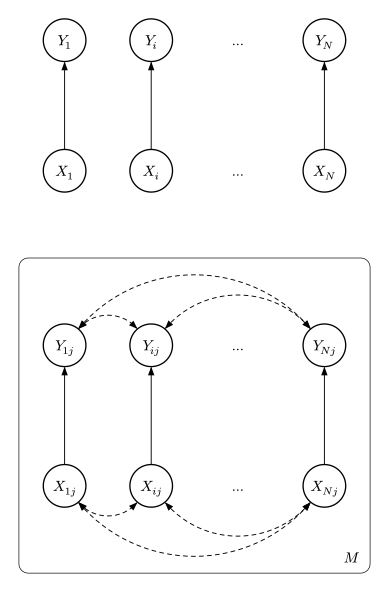
Multi-Level DA(M)G’s

\begin{aligned} Y_{\color{#D55E00}1} &= \mu^Y + \beta^{YX} X_{1} + U^{YX} X_{1} + U^{Y\mu} + E_{1}^Y \\ X_{\color{#D55E00}1} &= \mu^X + U^{X\mu} + E_{1}^X \\ Y_{\color{#D55E00}2} &= \mu^Y + \beta^{YX} X_{2} + U^{YX} X_{2} + U^{Y\mu} + E_{2}^Y \\ X_{\color{#D55E00}2} &= \mu^X + U^{X\mu} + E_{2}^X \\ Y_{\color{#D55E00}3} &= \mu^Y + \beta^{YX} X_{3} + U^{YX} X_{3} + U^{Y\mu} + E_{3}^Y \\ X_{\color{#D55E00}3} &= \mu^X + U^{X\mu} + E_{3}^X \end{aligned}

\begin{aligned} Y_{1} &= \color{#D55E00}f_{Y1}\color{black}(X_{1}, U^{Y\mu}, U^{YX}, E_{1}^Y) \\ X_{1} &= \color{#D55E00}f_{X1}\color{black}(U^{X\mu}, E_{1}^X) \\ Y_{2} &= \color{#D55E00}f_{Y2}\color{black}(X_{2}, U^{Y\mu}, U^{YX}, E_{2}^Y) \\ X_{2} &= \color{#D55E00}f_{X2}\color{black}(U^{X\mu}, E_{2}^X) \\ Y_{3} &= \color{#D55E00}f_{Y3}\color{black}(X_{3}, U^{Y\mu}, U^{YX}, E_{3}^Y) \\ X_{3} &= \color{#D55E00}f_{X3}\color{black}(U^{X\mu}, E_{3}^X) \end{aligned}

Distributional Assumptions

\begin{aligned} \begin{bmatrix} U_{j}^{X\mu}\\ U_{j}^{Y\mu}\\ U_{j}^{YX} \end{bmatrix} &\sim N \left ( \begin{bmatrix} 0\\ 0\\ 0 \end{bmatrix}, \begin{bmatrix} \psi_{U_{j}^{X\mu}} & & \\ \psi_{U_{j}^{X\mu} U_{j}^{Y\mu}} & \psi_{U_{j}^{Y\mu}} & \\ \psi_{U_{j}^{X\mu} U_{j}^{YX}} & \psi_{U_{j}^{Y\mu} U_{j}^{YX}} & \psi_{U_{j}^{YX}} \end{bmatrix} \right ) \\ \begin{bmatrix} E_{ij}^{X} \\ E_{ij}^{Y} \end{bmatrix} &\sim N\left (\begin{bmatrix} 0\\ 0 \end{bmatrix}, \begin{bmatrix} \sigma^2_{E^X} & \\ 0 & \sigma^2_{E^Y} \end{bmatrix}\right ) \end{aligned}

Mixed-Model Reduced Form

\begin{aligned} \mathbb E[Y_{ij} \mid X_{ij} = x_{ij}] &= \underbrace{\color{lightgray}{\mathbb{E}[Y] - \mu^X \cdot \text{slope}}}_{\text{intercept}} + \underbrace{\left(\color{#D55E00}\beta^{YX}\color{black} + \text{bias}\right)}_{\text{slope}} x_{ij} \end{aligned}

\text{bias} = \frac{ \color{#D55E00}\psi_{U^{X\mu} U^{Y\mu}} + \mu^X \psi_{U^{X\mu} U^{YX}} + \sigma_{E^X E^Y} }{\psi_{U^{X\mu}} + \sigma^2_{E^X}}

Mixed-Model Interventional Form

\begin{aligned} \mathbb E[Y_{ij} \mid do(X_{ij} = x_{ij})] &= \underbrace{ \mathbb{E}[Y] - \mu^X \cdot \color{#D55E00}\beta^{YX}\color{black} }_{ \text{intercept} } + \underbrace{ \color{#D55E00}\beta^{YX}\color{black} }_{ \text{slope} } x_{ij} \end{aligned}

Group-Mean Centering

X_{ij} - \bar{X}_j

Subtracting the group mean removes U_j^{X\mu} \approx \bar{X}_j

Multi-level Regression with Group Mean

\begin{aligned} y_{ij} &= \eta_{0j} + \eta_{1j}x_{ij} + e_{ij} \\ \eta_{0j} &= \mu + \color{#D55E00}\gamma_1 \bar x_j\color{black} + u_{0j} \\ \eta_{1j} &= \beta + \color{#D55E00}\gamma_2 \bar x_j\color{black} + u_{1j} \end{aligned}

Mixed-Model Notation

y_{ij} = (\mu + \color{#D55E00}\gamma_1 \bar x_j\color{black} + u_{0j}) + (\beta + \color{#D55E00}\gamma_2 \bar x_j\color{black} + u_{1j}) x_{ij} + e_{ij}

Mixed-Model Notation

y_{ij} = \mu + \color{#D55E00}\gamma_1 \bar x_j\color{black} + \beta x_{ij} + \color{#D55E00}\gamma_2 \bar x_j x_{ij}\color{black} + u_{1j}x_{ij} + u_{0j} + e_{ij}

Visualizations of Multilevel Models

(Parametric) Multilevel Causal Graphs

Confounding in Multilevel Settings

Variance Heterogeneity

Multi-level Location Scale Equations

\begin{aligned} X_{ij} &= \eta_{j}^{X\mu} + \color{#D55E00}\eta_{j}^{X\sigma}\color{black} E_{ij}^{X} \\ Y_{ij} &= \eta_{j}^{Y\mu} + \eta_{j}^{YX} X_{ij} + E_{ij}^{Y} \\ \\ \eta_{j}^{X\mu} &= \mu^{X} + U_{j}^{X\mu} \\ \color{#D55E00}\eta_{j}^{X\sigma} &\color{#D55E00}= \sigma^{X} + U_{j}^{X\sigma} \\ \eta_{j}^{Y\mu} &= \mu^{Y} + U_{j}^{Y\mu} \\ \eta_{j}^{YX} &= \beta^{YX} + U_{j}^{YX} \end{aligned}

Distributional Assumptions of Location-Scale Model

\begin{aligned} \begin{bmatrix} U_{j}^{X\mu}\\ \color{#D55E00} U_{j}^{X\sigma}\\ U_{j}^{Y\mu}\\ U_{j}^{YX} \end{bmatrix} &\sim N \left ( \begin{bmatrix} 0\\ 0\\ 0\\ 0 \end{bmatrix}, \begin{bmatrix} \psi_{U_{j}^{X\mu}} & & & \\ \color{#D55E00} \psi_{U_{j}^{X\mu} U_{j}^{X\sigma}} & \color{#D55E00} \psi_{U_{j}^{X\sigma}} & & \\ \psi_{U_{j}^{X\mu} U_{j}^{Y\mu}} & \color{#D55E00} \psi_{U_{j}^{X\sigma} U_{j}^{Y\mu}} & \psi_{U_{j}^{Y\mu}} & \\ \psi_{U_{j}^{X\mu} U_{j}^{YX}} & \color{#D55E00} \psi_{U_{j}^{X\sigma} U_{j}^{YX}} & \psi_{U_{j}^{Y\mu} U_{j}^{YX}} & \psi_{U_{j}^{YX}} \end{bmatrix} \right ) \\ \begin{bmatrix} E_{ij}^{X} \\ E_{ij}^{Y} \end{bmatrix} &\sim N\left (\begin{bmatrix} 0\\ 0 \end{bmatrix}, \begin{bmatrix} \color{#D55E00}1\color{black} & \\ 0 & \sigma^2_{E^Y} \end{bmatrix}\right ) \end{aligned}

Exercise: Multilevel Confounding

Fit progressively complex models on simulated data. Which ones recover the true causal effect — and why?

Open multilevel-confounding/multilevel-confounding.R

~30 min, then debrief.

The estimate may be Weighted Least Squares in Disguise

\mathrm{ATE}=\mathbb{E}[\beta^{YX}_j] \qquad\text{but}\qquad \beta^{YX}=\mathbb{E}[W_j\,\beta^{YX}_j]

where

W_j \propto \mathrm{Var}(X_{ij}\mid j), \qquad W_j > 0,

if

\mathrm{Cov}\!\left(U^{X\sigma}_j,\; U^{YX}_j\right)\neq 0.

Clusters with high variance get high weight, and those with low variance get low weight

With two crossed fixed effects, weights can go negative

\beta^{YX}_{\text{FE}}=\sum_{j,k}W_{jk}\;\beta^{YX}_{jk}, \qquad W_{jk}\lessgtr 0

Previously: W_j>0 (unequal but positive). With two crossed grouping factors — school \times cohort, state \times time — weights can flip sign.

The estimate can have the opposite sign of every cell-specific effect

De Chaisemartin and D’Haultfœuille (2020)

Medicaid expansion and preterm birth

Estimator Risk Difference
TWFE +0.12 (harmful)
Group-time ATT −0.16 (protective)
Target trial −0.16 (protective)

Same data. Sign flipped.

Goin and Riddell (2023)

References

Bates, Michael David, Katherine E. Castellano, Sophia Rabe-Hesketh, and Anders Skrondal. 2014. “Handling Correlations Between Covariates and Random Slopes in Multilevel Models.” Journal of Educational and Behavioral Statistics 39 (6): 524–49. https://doi.org/10.3102/1076998614559420.
Chernozhukov, Victor, Ivan Fernandez-Val, Jinyong Hahn, and Whittney Newey. 2013. “Average and Quantile Effects in Nonseparable Panel Models.” Econometrica 81 (2): 535–80. https://doi.org/10.3982/ECTA8405.
Curran, Patrick J., and Daniel J. Bauer. 2007. “Building Path Diagrams for Multilevel Models.” Psychological Methods 12 (3): 283–97. https://doi.org/10.1037/1082-989X.12.3.283.
De Chaisemartin, Clément, and Xavier D’Haultfœuille. 2020. “Two-Way Fixed Effects Estimators with Heterogeneous Treatment Effects.” American Economic Review 110 (9): 2964–96. https://doi.org/10.1257/aer.20181169.
Gelman, Andrew, Jessica Hullman, and Lauren Kennedy. 2023. “Causal Quartets: Different Ways to Attain the Same Average Treatment Effect.” Pre-published February 24. https://doi.org/10.48550/arXiv.2302.12878.
Goin, Dana E., and Corinne A. Riddell. 2023. “Comparing Two-way Fixed Effects and New Estimators for Difference-in-Differences: A Simulation Study and Empirical Example.” Epidemiology 34 (4): 535–43. https://doi.org/10.1097/EDE.0000000000001611.
Goodman, Steven N., Jesse Berlin, Suzanne W. Fletcher, and Robert H. Fletcher. 1994. “Manuscript Quality Before and After Peer Review and Editing at Annals of Internal Medicine.” Annals of Internal Medicine 121 (1): 11–21. https://doi.org/10.7326/0003-4819-121-1-199407010-00003.
Hardwicke, Tom E., Manuel Bohn, Kyle MacDonald, et al. 2021. “Analytic Reproducibility in Articles Receiving Open Data Badges at the Journal Psychological Science : An Observational Study.” Royal Society Open Science 8 (1): 201494. https://doi.org/10.1098/rsos.201494.
Klebel, Thomas, and Vincent Traag. 2024. “Introduction to Causality in Science Studies.” Pre-published February 9. https://doi.org/10.31235/osf.io/4bw9e.
Marsh, Herbert W., Marjorie Seaton, Ulrich Trautwein, et al. 2008. “The Big-fish–Little-Pond-Effect Stands Up to Critical Scrutiny: Implications for Theory, Methodology, and Future Research.” Educational Psychology Review 20 (3): 319–50. https://doi.org/10.1007/s10648-008-9075-6.
Mehta, Paras D., and Michael C. Neale. 2005. “People Are Variables Too: Multilevel Structural Equations Modeling.” Psychological Methods 10 (3): 259–84. https://doi.org/10.1037/1082-989X.10.3.259.
Muthén, Linda K., and Bengt O. Muthén. 2017. “Mplus User’s Guide (Eighth).” Muthén & Muthén.
Piwowar, Heather A., Roger S. Day, and Douglas B. Fridsma. 2007. “Sharing Detailed Research Data Is Associated with Increased Citation Rate.” PLoS ONE 2 (3): e308. https://doi.org/10.1371/journal.pone.0000308.
Ross-Hellauer, Tony, Thomas Klebel, Alexandra Bannach-Brown, et al. 2022. TIER2: Enhancing Trust, Integrity and Efficiency in Research Through Next-Level Reproducibility.” Research Ideas and Outcomes 8 (December): e98457. https://doi.org/10.3897/rio.8.e98457.
Skrondal, Anders, and S. Rabe-Hesketh. 2004. Generalized Latent Variable Modeling: Multilevel, Longitudinal, and Structural Equation Models. Chapman & Hall/CRC Interdisciplinary Statistics Series. Chapman & Hall/CRC.
Textor, Johannes, Benito van der Zander, Mark S Gilthorpe, Maciej Liśkiewicz, and George TH Ellison. 2016. “Robust Causal Inference Using Directed Acyclic Graphs: The R Package ‘Dagitty’.” International Journal of Epidemiology 45 (6): 1887–94. https://doi.org/10.1093/ije/dyw341.
Waltman, Ludo, and Nees Jan Van Eck. 2019. “Field Normalization of Scientometric Indicators.” In Springer Handbook of Science and Technology Indicators, edited by Wolfgang Glänzel, Henk F. Moed, Ulrich Schmoch, and Mike Thelwall. Springer International Publishing. https://doi.org/10.1007/978-3-030-02511-3_11.
Watson, Elijah, Delaney Glass, and Lucia Petito. 2025. “Toward New Directions in Human Biology: A Roadmap for Anthropological Causal Inference With Observational Data.” American Journal of Human Biology, ahead of print, September 22. https://doi.org/10.1002/ajhb.70149.
Woods, Helen Buckley, and Stephen Pinfield. 2022. “Incentivising Research Data Sharing: A Scoping Review.” Wellcome Open Research 6 (April): 355. https://doi.org/10.12688/wellcomeopenres.17286.2.